What we build.

Two Shapes of Problem

Most people can picture a new website or a mobile app. Almost nobody can picture what private AI actually does inside a business - so the conversation stalls at "interesting, but what would we even use it for?"

In practice, almost everything we build is one of two shapes. Either the answer already exists somewhere in your documents and nobody can find it, or the answer is split across systems that were never designed to talk to each other.

A useful test before you spend anything: a question is worth automating if no single system can answer it today, and nobody has built a report for it because it only gets asked now and then.

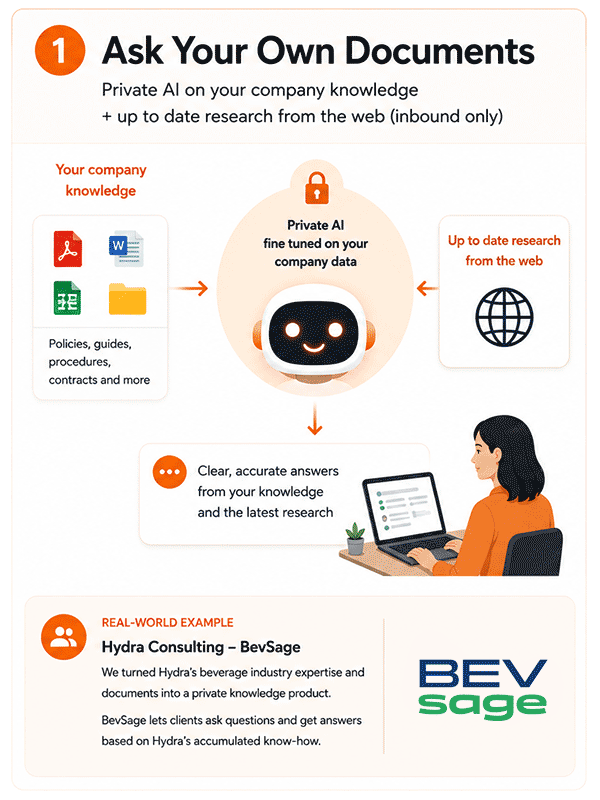
One: Ask Your Own Documents

Contracts, procedures, drawings, project history - indexed inside your own environment, where the material never leaves your infrastructure. This is not a search box. Search hands you ten documents and leaves you to read them; this gives you an answer and the passage it came from, so you can check it.

"Which of our current contracts have a liability cap below $2 million?"

"Which agreements auto-renew in the next ninety days, and who owns them?"

"Show me where our training materials cover this unit of competency - and where they don't."

"Have we specified this part before, and on which job?"

"What does a new estimator need to know before they call this account?"

Worth saying plainly: this is only ever as good as what was written down. If the knowledge lives in someone's head and never made it into a document, this will not find it.

Turning a Consultancy's Expertise Into a Product

Hydra Consulting's beverage-industry knowledge, built into BevSage - a product their clients query directly, running on TonsleyAI.

Client

Hydra Consulting / BevSage

Industry

Food & Beverage Consulting

Challenge

The expertise that made the consultancy valuable sat in its people and in years of accumulated documents. It could only be sold by the hour, and answers only moved as fast as the team could get to them.

Solution

Digit Implement with TonsleyAI - private AI over a curated body of domain knowledge
The raw material was already there: years of accumulated method and judgement, spread across documents nobody outside the firm could navigate. That is the ordinary starting position for this pattern - the knowledge exists, it just is not reachable.

We worked with Hydra Consulting to define what a good answer looked like: which sources were authoritative, what a trustworthy response had to include, and where the system had to defer rather than guess. That last point does most of the work. A tool that confidently invents an answer is worse than no tool at all, so the boundaries matter as much as the content.

The knowledge stays inside infrastructure the consultancy controls. The commercial shift matters more than the technology: expertise that could previously only be billed by the hour became something clients can subscribe to.

Two: Ask Across Your Systems

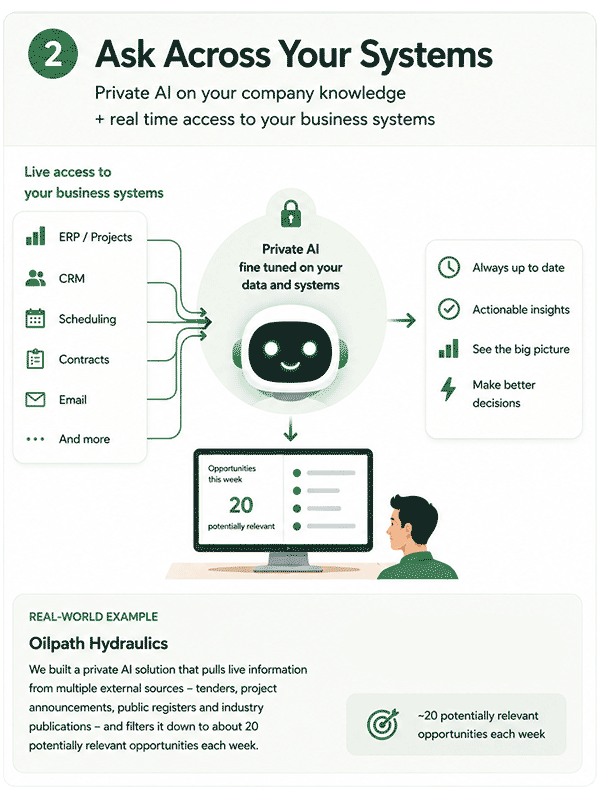
Your ERP, CRM, helpdesk, scheduling and finance, connected so a question can be asked once and answered in one place - instead of exporting three spreadsheets and reconciling them by hand. The questions worth building for are the ones no single system can answer, and that nobody has built a report for because they only come up now and then.

"Which customers are we actually losing money on?" Quoted price, hours booked, materials and support load sit in four different systems, which is why no report has ever shown it.

"This supplier just went into administration - what's exposed?" Which open orders, which jobs, which customers. The answer is worth far more within the hour than within the week.

"What have we promised in the next fortnight that we don't have the people or the stock for?"

"Why did job margin drop this quarter?" Not the number - the reason. That is a diagnosis, and it needs several systems read together.

But not this: "what was revenue last month?" If one system already answers a question, a dashboard is cheaper and better than anything we would build for you.

Worth saying plainly: this reads the systems you already have, so the answers are only as good as the data in them. A half-empty CRM shows up immediately - useful to know, but not what you set out to buy.

One Question, Asked Across Dozens of Sources

Tenders, public registers and industry publications, watched continuously and filtered down to the opportunities worth a call - around 20 a week.

Client

Oilpath Hydraulics

Industry

Industrial & Hydraulic Engineering

Challenge

The question - "what is worth quoting on this week?" - had no single place to be asked. The answer was spread across tenders, project announcements, public registers and industry publications. Monitoring them by hand took time, and broad keyword alerts produced more noise than useful leads.

Solution

Digit Automate - AI workflow design and lead-generation automation

We worked with Oilpath Hydraulics to define what counts as a relevant opportunity and translate that into an automated workflow: identifying the sectors, services and signals that matter, selecting suitable public sources, defining filtering and qualification criteria, and using AI to interpret and rank what it finds. The workflow supports commercial judgement rather than replacing it.

The system now identifies approximately 20 potentially relevant opportunities per week, giving Oilpath a repeatable source of business-development intelligence while cutting manual research effort - immediate operational value without an organisation-wide transformation.

The same shape applies inside a business rather than outside it. Where these sources are public registers, yours are more likely to be the ERP, the CRM and the scheduling system - but the mechanic is identical: one question, asked once, answered across everything that holds a piece of the answer.

"Have we done this before, and what did it cost us?" The precedent is in your documents. The cost is in your systems. Bring us the question you have never been able to answer.